What is seawater desalination? The mechanism of the RO membrane method [Basic knowledge]
Desalination of seawater to produce fresh water. This explains why the RO membrane method is mainstream, detailing the processes of one of the largest facilities in the country, as well as the handling of two-stage RO membranes and concentrated seawater.
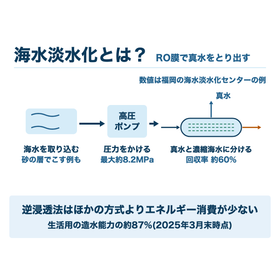
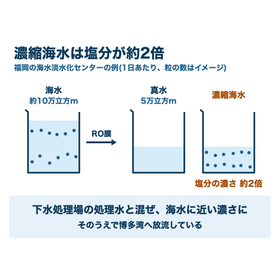
■Technology for Extracting Fresh Water from Seawater Seawater desalination is a technology that obtains fresh water by removing salt and other impurities from seawater. It is also used for removing impurities from groundwater that contains salt and other substances. The methods that have already been put into practical use include evaporation, reverse osmosis (RO membrane method), and electrodialysis. ■Why is the RO membrane method increasing? The reverse osmosis method is gaining popularity because it consumes less energy compared to other methods, leading to an increase in the number of plants. As of the end of March 2025, the desalination capacity for residential facilities (those producing more than 10 cubic meters per day) is approximately 87% for reverse osmosis and about 13% for electrodialysis. It has been used as a source of water for daily living in areas with scarce water resources, such as remote islands. ■Are Japanese facilities mostly small? As of the end of March 2025, domestic freshwater desalination plants have a total desalination capacity of about 110,000 cubic meters per day. Many seawater desalination plants for municipal water supply are small-scale, producing several dozen to several hundred cubic meters per day, with large-scale facilities of 50,000 cubic meters per day in Fukuoka Prefecture and 40,000 cubic meters per day in Okinawa Prefecture. Please feel free to consult with us first.
- Company:トリイ
- Price:Other